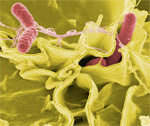
 Salmonella bacteria (photo credit FoodSafety.gov)
This article originally appeared on my blog for Flexcin International, Inc as Reading Pet Food Labels Can Save Lives
Why read the label on your pet’s food? Well, it's vital to the health of our pets that we’re aware of the ingredients that make up their food and treats. Unfortunately, most pet foods are made with sub standard ingredients. Consequently, we are fueling our pets’ bodies with substances that have been deemed unfit for human consumption. Are these less-than-human grade ingredients more appropriate for our pets than the higher quality foods that we eat? That's what the pet food industry wants consumers to believe.
Unfortunately for the various pet species eating these foods, nutrition is merely an afterthought. We treat our animals like family members, want high quality nutrition for them, and desire for their best lifelong health, but the everyday consumption of pet-grade food is poisoning our pets, either quickly or slowly.
You may be familiar with the largely publicized 2007 international pet food crisis that caused kidney failure and death in dogs and cats who consumed pet grade foods from China contaminated withmelamine. Melamine is a nitrogen-rich industrial chemical commonly found in plastic, flame retardants, and fertilizers. Melamine is absolutely not approved as an ingredient in human or animal food in the U.S. The end result is our pets suffered life threatening toxicity as a result of the pet food industry creating a cheap, poor quality product.
The positive outcome of this tragedy is the heightened awareness dog and cat owners developed about the nutritional value of ingredients in store bought pet foods. More recently, a variety of pet foods produced by Diamond were recalled after tracing Salmonella that sickened both pets and people. Salmonella is a bacterium that causes severe digestive disruption. This virulent microorganism can even cause kidney failure and death in both pets and people. Upon investigating this crisis, the FDA found subpar conditions in the environment where the foods were being produced.
Incidents similar to the melamine and Salmonella contaminations will continue to occur until a shift in perspective occurs. Pet owners must recognize that our pet’s best interests are served in providing human-grade, not feed-grade foods.
I hope this article encourages you to evaluate your pet’s current food. If you’re primarily providing feed-grade nutrition you may consider safer alternatives.
Stay tuned for more articles on how to read pet food labels, where I will also cover what ingredients you should avoid.
Thank you for reading my article. Your questions and comments are completely welcome (I’ll respond).
Please feel free to communicate with me through Twitter (@PatrickMahaney) and follow my adventures in veterinary medicine by liking Patrick Mahaney: Veterinarian Acupuncture Pain Management for Your Pets on Facebook.
Copyright of this article (2012) is owned by Dr Patrick Mahaney, Veterinarian and Certified Veterinary Acupuncturist. Republishing any portion of this article must first be authorized by Dr Patrick Mahaney. Requests for republishing must be approved by Dr Patrick Mahaney and received in written format. Salmonella bacteria (photo credit FoodSafety.gov)
This article originally appeared on my blog for Flexcin International, Inc as Reading Pet Food Labels Can Save Lives
Why read the label on your pet’s food? Well, it's vital to the health of our pets that we’re aware of the ingredients that make up their food and treats. Unfortunately, most pet foods are made with sub standard ingredients. Consequently, we are fueling our pets’ bodies with substances that have been deemed unfit for human consumption. Are these less-than-human grade ingredients more appropriate for our pets than the higher quality foods that we eat? That's what the pet food industry wants consumers to believe.
Unfortunately for the various pet species eating these foods, nutrition is merely an afterthought. We treat our animals like family members, want high quality nutrition for them, and desire for their best lifelong health, but the everyday consumption of pet-grade food is poisoning our pets, either quickly or slowly.
You may be familiar with the largely publicized 2007 international pet food crisis that caused kidney failure and death in dogs and cats who consumed pet grade foods from China contaminated withmelamine. Melamine is a nitrogen-rich industrial chemical commonly found in plastic, flame retardants, and fertilizers. Melamine is absolutely not approved as an ingredient in human or animal food in the U.S. The end result is our pets suffered life threatening toxicity as a result of the pet food industry creating a cheap, poor quality product.
The positive outcome of this tragedy is the heightened awareness dog and cat owners developed about the nutritional value of ingredients in store bought pet foods. More recently, a variety of pet foods produced by Diamond were recalled after tracing Salmonella that sickened both pets and people. Salmonella is a bacterium that causes severe digestive disruption. This virulent microorganism can even cause kidney failure and death in both pets and people. Upon investigating this crisis, the FDA found subpar conditions in the environment where the foods were being produced.
Incidents similar to the melamine and Salmonella contaminations will continue to occur until a shift in perspective occurs. Pet owners must recognize that our pet’s best interests are served in providing human-grade, not feed-grade foods.
I hope this article encourages you to evaluate your pet’s current food. If you’re primarily providing feed-grade nutrition you may consider safer alternatives.
Stay tuned for more articles on how to read pet food labels, where I will also cover what ingredients you should avoid.
Thank you for reading my article. Your questions and comments are completely welcome (I’ll respond).
Please feel free to communicate with me through Twitter (@PatrickMahaney) and follow my adventures in veterinary medicine by liking Patrick Mahaney: Veterinarian Acupuncture Pain Management for Your Pets on Facebook.
Copyright of this article (2012) is owned by Dr Patrick Mahaney, Veterinarian and Certified Veterinary Acupuncturist. Republishing any portion of this article must first be authorized by Dr Patrick Mahaney. Requests for republishing must be approved by Dr Patrick Mahaney and received in written format.
Salmonella bacteria (photo credit FoodSafety.gov)
This article originally appeared on my blog for Flexcin International, Inc as Reading Pet Food Labels Can Save Lives
Why read the label on your pet’s food? Well, it's vital to the health of our pets that we’re aware of the ingredients that make up their food and treats. Unfortunately, most pet foods are made with sub standard ingredients. Consequently, we are fueling our pets’ bodies with substances that have been deemed unfit for human consumption. Are these less-than-human grade ingredients more appropriate for our pets than the higher quality foods that we eat? That's what the pet food industry wants consumers to believe.
Unfortunately for the various pet species eating these foods, nutrition is merely an afterthought. We treat our animals like family members, want high quality nutrition for them, and desire for their best lifelong health, but the everyday consumption of pet-grade food is poisoning our pets, either quickly or slowly.
You may be familiar with the largely publicized 2007 international pet food crisis that caused kidney failure and death in dogs and cats who consumed pet grade foods from China contaminated withmelamine. Melamine is a nitrogen-rich industrial chemical commonly found in plastic, flame retardants, and fertilizers. Melamine is absolutely not approved as an ingredient in human or animal food in the U.S. The end result is our pets suffered life threatening toxicity as a result of the pet food industry creating a cheap, poor quality product.
The positive outcome of this tragedy is the heightened awareness dog and cat owners developed about the nutritional value of ingredients in store bought pet foods. More recently, a variety of pet foods produced by Diamond were recalled after tracing Salmonella that sickened both pets and people. Salmonella is a bacterium that causes severe digestive disruption. This virulent microorganism can even cause kidney failure and death in both pets and people. Upon investigating this crisis, the FDA found subpar conditions in the environment where the foods were being produced.
Incidents similar to the melamine and Salmonella contaminations will continue to occur until a shift in perspective occurs. Pet owners must recognize that our pet’s best interests are served in providing human-grade, not feed-grade foods.
I hope this article encourages you to evaluate your pet’s current food. If you’re primarily providing feed-grade nutrition you may consider safer alternatives.
Stay tuned for more articles on how to read pet food labels, where I will also cover what ingredients you should avoid.
Thank you for reading my article. Your questions and comments are completely welcome (I’ll respond).
Please feel free to communicate with me through Twitter (@PatrickMahaney) and follow my adventures in veterinary medicine by liking Patrick Mahaney: Veterinarian Acupuncture Pain Management for Your Pets on Facebook.
Copyright of this article (2012) is owned by Dr Patrick Mahaney, Veterinarian and Certified Veterinary Acupuncturist. Republishing any portion of this article must first be authorized by Dr Patrick Mahaney. Requests for republishing must be approved by Dr Patrick Mahaney and received in written format. Salmonella bacteria (photo credit FoodSafety.gov)
This article originally appeared on my blog for Flexcin International, Inc as Reading Pet Food Labels Can Save Lives
Why read the label on your pet’s food? Well, it's vital to the health of our pets that we’re aware of the ingredients that make up their food and treats. Unfortunately, most pet foods are made with sub standard ingredients. Consequently, we are fueling our pets’ bodies with substances that have been deemed unfit for human consumption. Are these less-than-human grade ingredients more appropriate for our pets than the higher quality foods that we eat? That's what the pet food industry wants consumers to believe.
Unfortunately for the various pet species eating these foods, nutrition is merely an afterthought. We treat our animals like family members, want high quality nutrition for them, and desire for their best lifelong health, but the everyday consumption of pet-grade food is poisoning our pets, either quickly or slowly.
You may be familiar with the largely publicized 2007 international pet food crisis that caused kidney failure and death in dogs and cats who consumed pet grade foods from China contaminated withmelamine. Melamine is a nitrogen-rich industrial chemical commonly found in plastic, flame retardants, and fertilizers. Melamine is absolutely not approved as an ingredient in human or animal food in the U.S. The end result is our pets suffered life threatening toxicity as a result of the pet food industry creating a cheap, poor quality product.
The positive outcome of this tragedy is the heightened awareness dog and cat owners developed about the nutritional value of ingredients in store bought pet foods. More recently, a variety of pet foods produced by Diamond were recalled after tracing Salmonella that sickened both pets and people. Salmonella is a bacterium that causes severe digestive disruption. This virulent microorganism can even cause kidney failure and death in both pets and people. Upon investigating this crisis, the FDA found subpar conditions in the environment where the foods were being produced.
Incidents similar to the melamine and Salmonella contaminations will continue to occur until a shift in perspective occurs. Pet owners must recognize that our pet’s best interests are served in providing human-grade, not feed-grade foods.
I hope this article encourages you to evaluate your pet’s current food. If you’re primarily providing feed-grade nutrition you may consider safer alternatives.
Stay tuned for more articles on how to read pet food labels, where I will also cover what ingredients you should avoid.
Thank you for reading my article. Your questions and comments are completely welcome (I’ll respond).
Please feel free to communicate with me through Twitter (@PatrickMahaney) and follow my adventures in veterinary medicine by liking Patrick Mahaney: Veterinarian Acupuncture Pain Management for Your Pets on Facebook.
Copyright of this article (2012) is owned by Dr Patrick Mahaney, Veterinarian and Certified Veterinary Acupuncturist. Republishing any portion of this article must first be authorized by Dr Patrick Mahaney. Requests for republishing must be approved by Dr Patrick Mahaney and received in written format.